Victoria Park Primary School
Grammar and Punctuation
Main and Subordinate Clauses
Please remember to send completed work as pictures to your teacher via the Seesaw app. If you require any assistance in relation to this, please feel free to contact us as below: Rm 13 Mrs McKnight - lmcknight474@c2kni.net or Rm 14 Mr Ryden - dryden451@c2kni.net
What are phrases and clauses? | Oxford Owl
Learn how to use sentences, phrases and clauses with our fun animation. Perfect to help with grammar homework and to prepare for the Key Stage 2 SATs test.Fi...
What is a subordinate clause? | Oxford Owl
Learn the difference between a clause, a subordinate clause and a relative clause. Perfect to help with grammar homework and to prepare for the Key Stage 2 S...
Monday
Have a look through the presentation before completing the worksheets below.
Remember you can use the screen shot and edit function on Tablets / IPad / Mobile phones to highlight main and subordinate clauses.
Tuesday
Have a look through the presentation before completing the worksheets below.
Remember you can write these answers out or use the screen shot and edit function on Tablets / IPad / Mobile phones to type over the document.
Wednesday
Extension Activity
Sections to complete:
Group 1: Challenge 1-4
Group 2 & 3: Challenge 1-3
Group 4: Challenge 1-2
Thursday
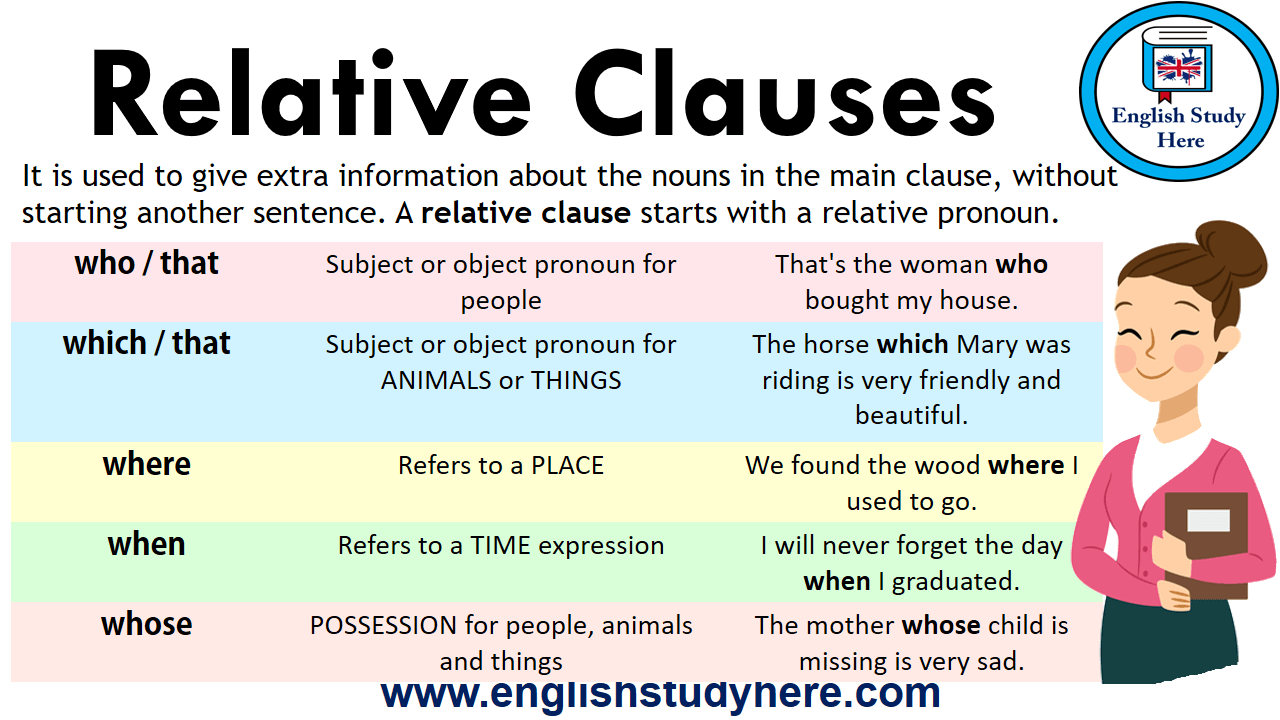
Relative clauses
A relative clause is a specific type of subordinate clause that adapts, describes or modifies a noun.
Relative clauses add information to sentences by using a relative pronoun such as who, that or which.
| Relative pronoun | Noun that the pronoun refers to |
| who | Refers to a person |
| which | Refers to an animal, place or thing |
| that | Can refer to a person, place or thing |
The relative clause is used to add information about the noun, so it must be ‘related’ to the noun.
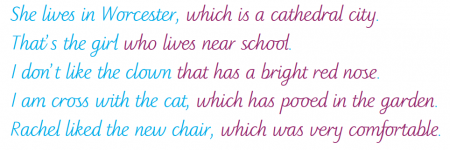
Here are some examples of relative clauses (in purple):
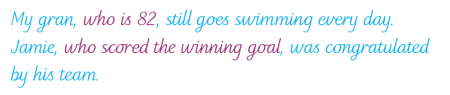
A relative clause can also be an embedded clause if it is positioned in the middle of a sentence, for example:
Friday
Mini quiz for Fun Friday 